
A camera off the cloud — custom firmware for the Conecto Bullet 6S
A cheap security camera with 8 MB of flash, an ARMv5 core and a hard dependency on the Tuya cloud. I dumped the firmware over UART and wrote my own RTSP server in C.
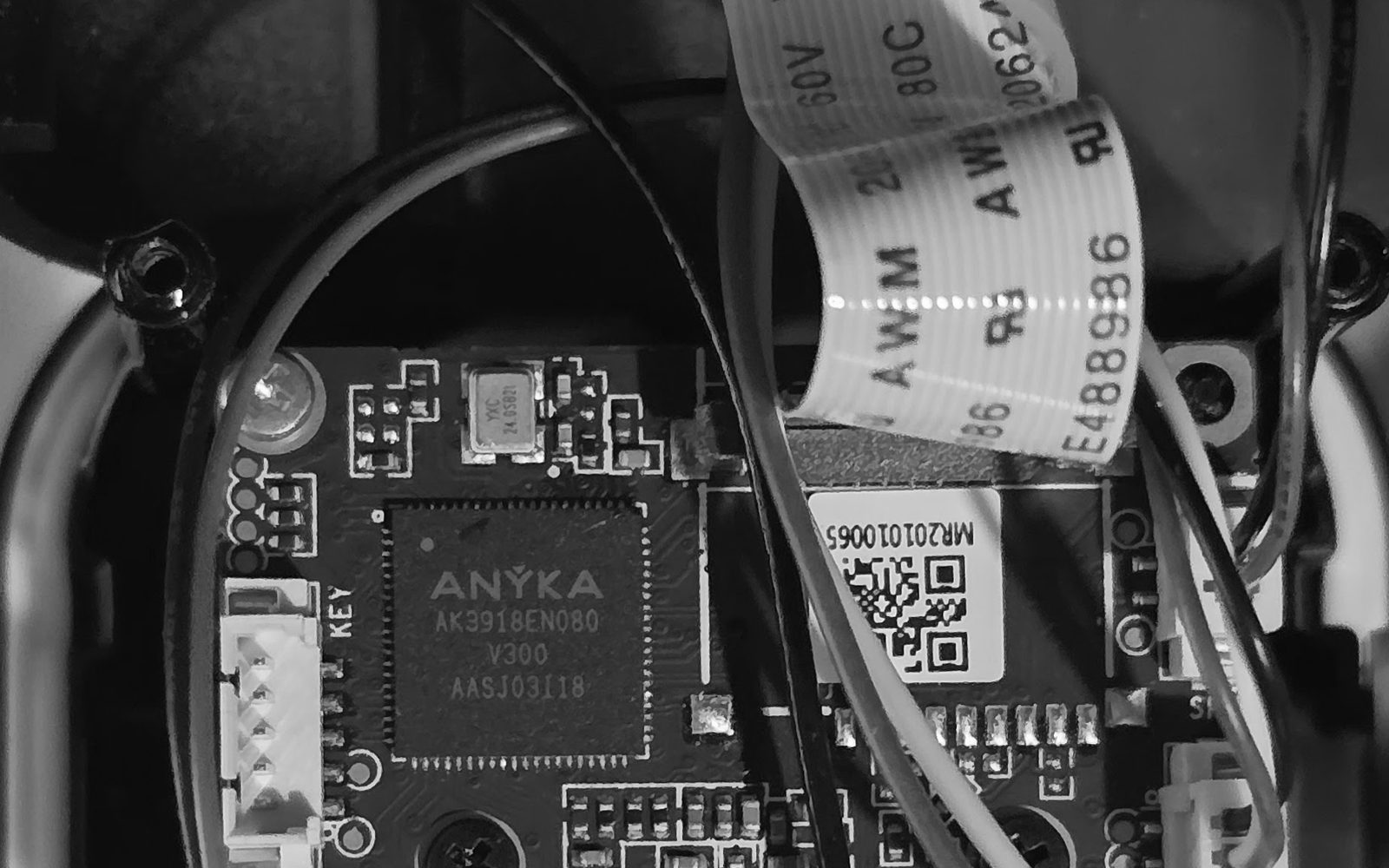
I bought a cheap security camera and immediately hit the problem: it only worked through the vendor's app. Video travelled to a Tuya cloud server abroad and back, latency was measured in seconds, and if the internet was down the camera was useless. I wanted an RTSP stream on my own network and a device that never reaches outside at all.
The result: it now runs entirely on my own firmware, offline, and switches to night vision by itself.
Hardware
| Model | Conecto Bullet Outdoor 6S |
| SoC | Anyka AK3918EN080 V300, ARMv5 (ARM926EJ-S) |
| Sensor | GC2053, 1080p |
| WiFi | RTL8188FTV, 2.4 GHz only |
| RAM | 64 MB |
| Flash | 8 MB SPI NOR |
| Stock OS | PPStrong A3 + Tuya, Linux 3.4.35, uClibc 0.9.33 |
1 — In through the serial port
It started on the board. There's a UART on it, which gives you the boot log and eventually the filesystem. U-Boot was password protected, and the password sat in plain sight in the bootloader's strings.
The first real step wasn't writing, it was reading: dump the whole flash before changing anything. That copy saved the device twice.
2 — My own RTSP server
No prebuilt binary works here. The AK3918 is ARMv5 and the OS leans on a uClibc from years ago. So I wrote an RTSP server in C for the video and audio streams and cross-compiled it with the right toolchain.
$ arm-anykav200-linux-uclibcgnueabi-gcc \
    -Os -ffunction-sections -Wl,--gc-sections \
    -o rtspd main.c rtsp.c audio.c
$ ls -l rtspd
-rwxr-xr-x  1  148K  rtspd
Eight megabytes of flash dictates everything: every library you don't need gets left out, and -Os plus --gc-sections are requirements rather than optimisations.
Audio followed as its own server, G.711 µ-law at 8 kHz. Without RTCP Sender Reports the audio and video drifted apart within minutes, so both had to be anchored to the wall clock.
3 — Night vision
The IR-cut filter and IR LEDs now switch automatically with the light level, read straight off the ISP's luminance value. The camera needs nothing external to decide.
4 — Bricking it, and getting back
The first flash didn't finish and the device stopped booting. Because the original dump was safe, I wrote a recovery firmware that brings the camera back over UART. It ships as part of the release now: nobody should start this without a return ticket.
What it ended up with
- RTSP video at
rtsp://<ip>/ch0(1080p) and/ch1(360p) - RTSP audio at
rtsp://<ip>:8554/audio, TCP interleaved - Automatic day/night switching
- No Tuya, no cloud, no outbound connections
- Recovery firmware for UART restore
The same SoC turns up in a lot of cheap PPStrong and Meari based cameras, so the approach isn't specific to this model.